
J. Rieger & Co. does something that would get most distillers laughed out of Kentucky: they add sherry to their whiskey. Not as a finish, not as a barrel treatment, but as a deliberate ingredient — a splash of 15-year-old Oloroso sherry blended directly into the bottle. In an industry that treats the Bottled-in-Bond Act like scripture and views any deviation from corn-rye-barley orthodoxy as heresy, Rieger's flagship product doesn't even qualify as bourbon. They call it Kansas City Whiskey, because that's what it is — a category they essentially invented by looking backward to pre-Prohibition blending practices that the rest of the industry forgot. That operational confession tells you everything about how this distillery thinks. They aren't chasing the same allocated-bourbon hype cycle as everyone else. They're running a completely different playbook in a city most whiskey drinkers wouldn't think to look at — and the liquid in the bottle is more interesting for it. The question worth asking isn't whether J. Rieger makes good whiskey. It's whether their particular brand of rule-breaking produces something your palate actually wants. That depends on what you're comparing it to, and what you're willing to try.

The original J. Rieger & Co. was founded in 1887 by Jacob Rieger, an Austrian immigrant who set up shop in Kansas City’s West Bottoms district and built it into the largest mail-order whiskey house in the country. The operation was massive — over 100 different alcoholic products at its peak, fueled by KC’s wide-open reputation as a town that liked its drinking unregulated and its mustaches handlebar-shaped. Then Prohibition arrived in 1919 and shut the whole thing down. For nearly a century, the Rieger name was a historical footnote.
The resurrection came in 2014, when Andy Rieger — Jacob’s great-great-great-grandson — partnered with Kansas City bartender Ryan Maybee to bring the brand back. They set up operations at 2700 Guinotte Avenue in the Electric Park District, a neighborhood defined by active railroad tracks and industrial character rather than tourist polish.
The location matters for reasons beyond atmosphere. Kansas City sits on the Missouri River basin, and the municipal water’s mineral content plays a role in fermentation. The climate is the bigger factor. Midwestern weather swings from aggressively hot summers to bitter winters, sometimes within the same week. Those temperature fluctuations force barrel-aged spirits to expand into the wood and contract back out at a pace that more temperate climates can’t match.
The bourbon mashbill at J. Rieger runs 56% corn, 30% rye, and 14% malted barley. That 30% rye is significant — it’s substantially higher than the 8-15% rye content in most traditional bourbon mashbills, which means the grain character leans harder into spice and herbal notes before the barrel ever gets involved.
Their Straight Rye Whiskey pushes even further, reportedly running a 96% rye grain bill. That’s not a rye that barely qualifies for the name at 51%. It’s a spirit built almost entirely on one grain, which produces a punchy, spice-forward, herbal profile.
Where Rieger gets particularly interesting is in the fermentation. Most American distilleries use a sour mash process — recycling spent mash from the previous batch to control pH and maintain consistency. J. Rieger uses sweet mash. Every fermentation starts completely fresh — new cooked grains, fresh water, fresh yeast. It’s harder to manage because the risk of bacterial contamination is higher without the pH control that backset provides. But the payoff is a cleaner, brighter distillate with more defined fruit and floral characteristics.
The yeast strains they select are chosen for flavor complexity rather than speed. The fermentation runs long, which stresses the yeast and pushes it to produce a wider range of esters and congeners — the chemical compounds responsible for fruit, flower, and spice notes in the finished spirit.
J. Rieger runs a hybrid distillation setup using both a 750-gallon copper pot still and column stills. The column still handles the initial stripping run. The pot still then does the second distillation, a slower batch process that retains the heavier, oilier flavor compounds that column-only distillation tends to strip away.
The production team was trained by two genuine heavyweights. The late Dave Pickerell — the distiller behind Maker’s Mark’s rise and later WhistlePig’s success — was instrumental in establishing the operation. Tom Nichol, formerly of Tanqueray, brought a gin-world precision to the spirit-cutting process. Master Distiller Nathan Perry, who leads the current six-person team, learned directly from both.
J. Rieger ages in standard 53-gallon new charred American white oak barrels. The aging happens in their own rickhouse in Kansas City, and the climate does meaningful work. Summer heat pushes the spirit deep into the wood grain; winter cold pulls it back.
There’s also the train factor. The Rieger rickhouse sits directly adjacent to active freight railroad tracks. The vibration from heavy rail traffic agitates the barrels constantly, keeping the liquid in motion and increasing contact with the wood surface.
The most distinctive aging program at Rieger is the Solera system used for their Monogram Whiskey. They imported ten Oloroso sherry botas — massive casks between 50 and 100 years old — from the Williams & Humbert bodega in Jerez, Spain. In 2017, they became the first U.S. distillery granted permission by the Spanish government to import sherry in bulk rather than in bottled form. The Solera works through fractional blending: they never fully empty the botas. They pull a portion out for bottling, then refill with new whiskey, which mingles with the older stock. The botas themselves contribute dried-fruit, walnut, and nutty oxidative notes that layer underneath the bourbon and rye character.
Nathan Perry is the Head Distiller at J. Rieger & Co., leading a six-person production team. He learned directly under Dave Pickerell, who spent 14 years as Master Distiller at Maker’s Mark. Perry also trained under Tom Nichol, whose career at Tanqueray gave him a precision approach to distillation that most bourbon-focused distillers never encounter.
Perry’s operational philosophy centers on control and intentionality. The sweet mash process requires substantially more cleaning and sanitation than sour mash. His team handles the fermentation monitoring, the manual still cuts, and the blending decisions that shape the final products. The distillery’s co-founder Ryan Maybee brings a bartender’s palate to the blending process, which shows up most clearly in the Kansas City Whiskey.
Rieger’s Kansas City Whiskey — 92 proof, approximately $30-35. This is the bottle that defines the distillery. It’s a blend of straight bourbon, straight rye, and light corn whiskey, finished with a touch of 15-year-old Oloroso sherry. The sherry adds dried fruit, raisin, and nutty complexity on top of the rye spice and corn sweetness from the base whiskeys. It’s an outstanding cocktail whiskey — the complexity stands up in an Old Fashioned or Manhattan without getting lost.
J. Rieger & Co. Straight Bourbon Whiskey — Bottled-in-Bond, 100 proof, minimum 4 years aged, approximately $40-50. This is Rieger doing traditional bourbon, straight. The 56/30/14 mashbill produces a rich, full-bodied pour with more rye spice than most standard bourbons.
J. Rieger & Co. Straight Rye Whiskey — 100 proof, approximately $40-50. Built on that reported 96% rye mashbill, this is an aggressive, grain-forward rye with serious backbone.
Monogram Whiskey (Solera Reserva) — 100 proof, limited annual release, approximately $130. This is the crown jewel. The sherry-bota influence is more pronounced here than in the Kansas City Whiskey — dried fig, walnut, oxidative nuttiness, layered over bourbon richness.
Rieger’s Caffè Amaro — 56 proof, approximately $30-35. Not a whiskey, but worth knowing about. Coffee beans from a local KC roaster are infused into spent whiskey barrels, then blended with botanicals.
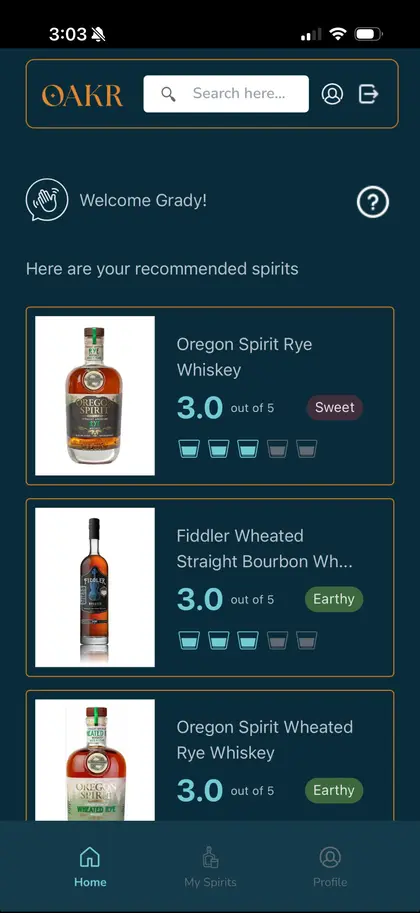
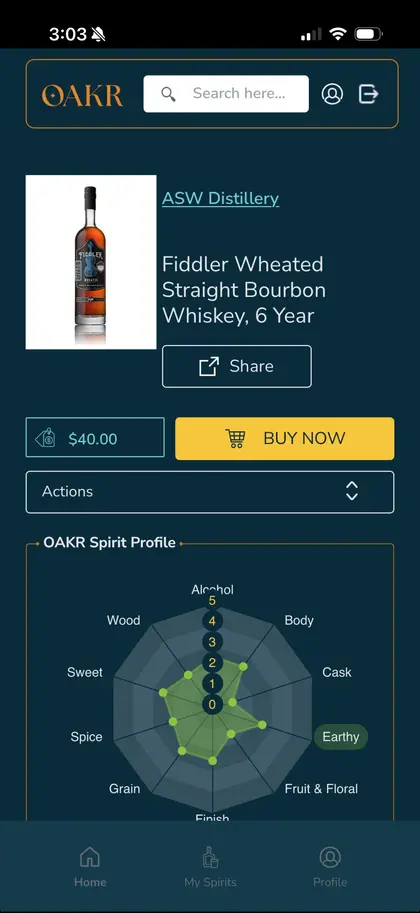
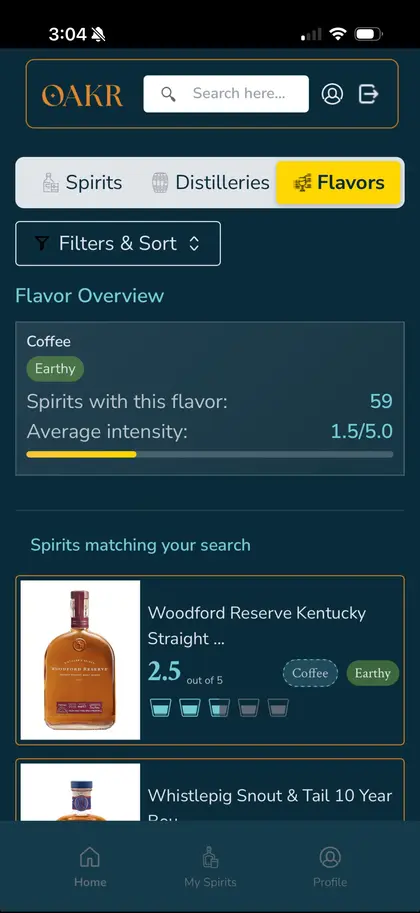
OAKR’s blind tasting panel scores over 100 individual flavor notes across 10 macro categories for every spirit in our database. Your Spirit Match score tells you whether the sherry-kissed complexity of the Kansas City Whiskey is going to land for you, or whether you’d be better served by the BiB Bourbon’s more traditional profile, before you spend a dollar.
[Download OAKR free on iOS, Android, or web →]

Bourbon enthusiast, spirits industry analyst, and the voice behind OAKR's distillery guides, brand reviews, and bourbon education content. Visiting distilleries, dissecting mashbills, and translating the craft into data since 2024.
Sherry-blended whiskey, Solera-aged reserves, 96% rye. Your Spirit Match score maps J. Rieger’s unconventional profile against your palate.