
A bottle of Jim Beam White Label costs about $18 and outsells every other bourbon on the planet. A bottle of Jim Beam Lineage — the 15-year-old, 111-proof collaboration between Fred and Freddie Noe — costs $250, is only available at the Clermont distillery, and is the first Beam bourbon to carry the eighth generation’s name on the label. Both bottles share the same mashbill, the same yeast strain, and the same limestone water. The $232 gap between them is explained entirely by barrel selection, aging time, and proof management — production variables that tell you more about how bourbon works than most distillery marketing ever will. Jim Beam produces nearly half of the world’s bourbon. That statistic alone should make you pay attention, because achieving global-scale consistency with a living, biological product — one that depends on yeast, wood, and weather — is arguably the most difficult technical challenge in the spirits industry. Every bottle of White Label sold in 170+ countries has to taste identical. That isn’t luck. It’s an obsessive, eight-generation commitment to process control that starts with a proprietary yeast strain and ends with a blending operation that averages out the barrel-to-barrel variation across millions of barrels aging in Kentucky rickhouses. The interesting question isn’t whether Jim Beam is good bourbon — it’s which Jim Beam matches your palate. The lineup spans from a $18 mixer to a $250 collector’s bottle, with the small-batch collection (Knob Creek, Basil Hayden’s, Baker’s, Booker’s) occupying the middle ground where serious whiskey drinkers tend to find their favorites. Understanding the shared DNA underneath all of those labels is the key to navigating the portfolio efficiently.

Jacob Beam sold his first barrel of corn whiskey in Kentucky in 1795. Eight generations later, the Beam family still makes bourbon in Clermont, Kentucky, at what is now the James B. Beam Distilling Co. campus. The distillery is owned by Suntory Global Spirits, a Japanese parent company, but the production operation has remained under Beam family leadership continuously — a distinction that matters because the family controls the yeast strain, the blending decisions, and the quality standards that define the brand.
The defining moment in Jim Beam history isn’t the founding. It’s what happened after Prohibition. Colonel James B. Beam — the “Jim” on the label — rebuilt the entire Clermont distillery from scratch in 120 days at the age of 70. More critically, he had preserved the proprietary yeast culture through the 13 dry years, carrying a jug of it home every weekend to keep the organism alive. When the stills fired up again, the bourbon tasted the same as it had before Prohibition. That biological continuity is the foundation everything else is built on.
The Clermont campus sits on the Kentucky limestone shelf, drawing water from a nearby spring-fed lake. The water is naturally iron-free and calcium-rich — iron produces off-flavors in fermentation, while calcium supports yeast health. Kentucky’s dramatic seasonal temperature swings (90°F+ summers, freezing winters) drive the barrel maturation cycle that gives bourbon its color and a significant portion of its flavor. Jim Beam ages its bourbon in massive, multi-story rickhouses designed to maximize this temperature cycling across different floor levels.
The Jim Beam bourbon mashbill is approximately 75% corn, 13% rye, and 12% malted barley. This ratio has not changed. It’s a high-corn, low-rye formula that prioritizes sweetness and approachability over spice. The 75% corn content delivers the caramel, vanilla, and toasted grain sweetness that defines the Beam flavor baseline. The 13% rye adds enough pepper and baking spice to provide structure without competing with the corn’s sweetness. The malted barley provides the enzymes necessary for starch conversion during mashing.
This same mashbill runs through the entire bourbon portfolio — White Label, Black Label, Bonded, Devil’s Cut, Double Oak, and the small-batch collection. The flavor differences between those products come from aging time, barrel placement, proof management, and blending decisions, not from different grain recipes. When you drink Knob Creek or Booker’s, you’re drinking the same grain DNA as White Label, just aged longer, proofed differently, and selected from different positions in the rickhouse.
The more consequential ingredient is the yeast. Jim Beam maintains a proprietary yeast strain that has been in continuous cultivation since the end of Prohibition — over 90 years of unbroken biological continuity. This strain is a fast, aggressive fermenter that produces a distinctive ester profile: nutty, slightly fruity, with a characteristic “peanut shell” note that bourbon enthusiasts call “Beam funk.” You either notice it and like it, or you notice it and don’t. Either way, it’s the organism’s signature, and it’s present in every Beam product.
The yeast is treated as the distillery’s most critical asset. Backup cultures are maintained under controlled conditions. The strain’s consistency is why a bottle of White Label purchased in Tokyo tastes identical to one purchased in Clermont. Change the yeast, and every product in the portfolio changes with it — same corn, same barrels, same water, fundamentally different bourbon.
Jim Beam uses a hybrid distillation system: massive copper column stills for the primary distillation, followed by a doubler (essentially a pot still) for the secondary distillation. The column still handles the volume — this is how you produce enough bourbon to supply half the global market. The fermented mash (distiller’s beer) is pumped through the column, where steam strips the alcohol from the solids, producing a spirit called “low wine” at approximately 125 proof.
The low wine then passes through the doubler, which provides a second distillation in a pot-still-like vessel. This step refines the spirit, smoothing rough edges while retaining the heavier flavor compounds — including the nutty, fruity esters produced by the proprietary yeast. The resulting “high wine” comes off at less than 160 proof, as required by law.
The column-plus-doubler approach is the classic American bourbon distillation method, but Jim Beam runs it at a scale that few other distilleries can match. The engineering challenge isn’t the equipment — it’s maintaining consistency across millions of gallons of annual production while preserving the specific flavor character that defines the brand. The sour mash process (using spent mash from the previous batch to regulate pH in the new fermentation) adds another layer of consistency control.
The spirit enters the barrel at no more than 125 proof, the legal maximum. Jim Beam uses new American white oak barrels with a Level 4 “alligator char” — a deep char that creates a thick layer of caramelized wood sugar and charcoal on the barrel interior. This heavy char is the primary source of the vanilla, caramel, and toffee notes that define the flavor profile across the portfolio.
Jim Beam ages its bourbon for a minimum of four years — double the two-year legal minimum for “straight” bourbon. The barrels are stored in multi-story rickhouses across the Clermont campus, where barrel placement within the building significantly affects the maturation profile. Top-floor barrels experience higher temperatures, more aggressive wood interaction, and produce darker, more concentrated whiskey. Lower-floor barrels age more slowly and produce lighter, more delicate character.
For the flagship White Label, barrels from across all rickhouse locations and floors are blended to achieve a uniform flavor profile. The individual personality of each barrel is intentionally averaged out — the goal is absolute consistency. For the small-batch collection, the blending and selection criteria become more specific: Knob Creek pulls from specific aging zones, Booker’s is bottled uncut and unfiltered at barrel proof from selected barrels, and Baker’s targets a particular flavor profile through specific rickhouse and floor selection.
The 2026 release of Jim Beam Double Oak represents a newer approach: the bourbon is aged in standard charred oak barrels, then transferred to a second freshly charred barrel for additional maturation. The double-barrel treatment amplifies the vanilla and caramel extraction while adding extra layers of toasted oak complexity.
Fred Noe is the seventh-generation Beam family Master Distiller — the great-grandson of Jim Beam himself and the son of Booker Noe, the legendary distiller who created the small-batch bourbon category with the launch of Booker’s, Baker’s, Basil Hayden’s, and Knob Creek. Fred earned his position by working every job in the distillery, from rolling barrels to cleaning mash tuns. His approach is practical and unpretentious: make great bourbon, maintain the family recipe, and don’t overcomplicate things.
Freddie Noe, Fred’s son, became the eighth-generation Master Distiller in May 2022. He grew up on the distillery grounds, studied the science of distillation, and has brought a more experimental sensibility to the portfolio. His signature project is the Little Book Whiskey series — an annual limited release that showcases unconventional blending and aging experiments. Little Book is where the Beam operation takes creative risks that the flagship products can’t.
The Lineage series, launched in 2021 and re-released as Batch #2 in 2025, represents the intersection of both distillers’ philosophies. It’s a 15-year-old bourbon hand-selected by Fred and Freddie together — the first Beam bourbon to carry Freddie’s name on the label alongside his father’s. At 111 proof and $250, it’s the portfolio’s ceiling: proof that the same mashbill and yeast strain that produces $18 White Label can, with 15 years of aging and precise barrel selection, produce whiskey that competes with allocated bourbon at a fraction of the secondary-market markup.
Jim Beam White Label — 80 proof, approximately $16-20. Four years aged. The world’s best-selling bourbon. Sweet corn, vanilla, light oak, and a hint of the signature nutty yeast character. This is a mixing bourbon — it does its best work in cocktails and highballs. Neat, it’s simple and straightforward. The value proposition is hard to argue with: consistent, available everywhere, and priced below most competitors.
Jim Beam Black Label — 86 proof, approximately $20-25. Extra-aged (approximately 7-8 years). A richer, more developed version of White Label — deeper caramel, more pronounced vanilla, and smoother oak integration. The additional barrel time mellows the yeast funk and adds complexity. An underrated sipper and an excellent cocktail upgrade over White Label.
Jim Beam Bonded — 100 proof, minimum 4 years, single distilling season, approximately $20-25. The Bottled-in-Bond designation guarantees specific production standards. At 100 proof, it has more body and intensity than White Label, with enough structure to hold up in any cocktail. One of the best values in bourbon at its price point.
Jim Beam Double Oak — 86 proof, approximately $20-25. Released early 2026. Aged first in standard charred oak barrels, then transferred to freshly charred barrels for a second maturation. The double-barrel treatment pushes the vanilla, caramel, and toasted oak notes further than the standard lineup. Sweeter and richer than Black Label.
Knob Creek — 100 proof, 9 years aged, approximately $32-38. The anchor of the small-batch collection. Full-bodied, oak-forward, with caramel, vanilla, toasted nut, and a longer, more complex finish than anything in the standard lineup. This is the Beam product that converts people who think they don’t like Beam. The Single Barrel and Cask Strength expressions push even further into rich, concentrated territory.
Booker’s — Barrel proof (typically 121-130 proof), 6-8 years aged, approximately $90-100. Uncut, unfiltered, straight from the barrel. Named for Booker Noe (Fred’s father), this is the expression that proves what the Beam mashbill and yeast can do at full intensity. Dark caramel, roasted peanut, heavy oak, vanilla, and serious heat. Batch-to-batch variation means each release has its own character.
Jim Beam Lineage Batch #2 — 111 proof, 15 years aged, approximately $250. Distillery exclusive. The father-son collaboration between Fred and Freddie Noe — hand-selected 15-year-old barrels from the Booker Noe Plant. Toasted oak, brown sugar, baking spice, orange peel, and refined peanut brittle. The most mature, complex expression the distillery has released in its modern era.
The entire Jim Beam portfolio — from the $18 White Label to the $250 Lineage — shares the same mashbill, the same yeast strain, and the same water source. The flavor range across that spectrum demonstrates what aging, barrel selection, and proof management actually do to a spirit’s character. It’s a controlled experiment in bourbon production, and the variables are clearly labeled on every bottle.
The challenge is figuring out where on that spectrum your palate lives. The nutty, corn-sweet “Beam funk” that defines every product in the lineup either works for you or it doesn’t — and the only way to know before buying across the portfolio is data.
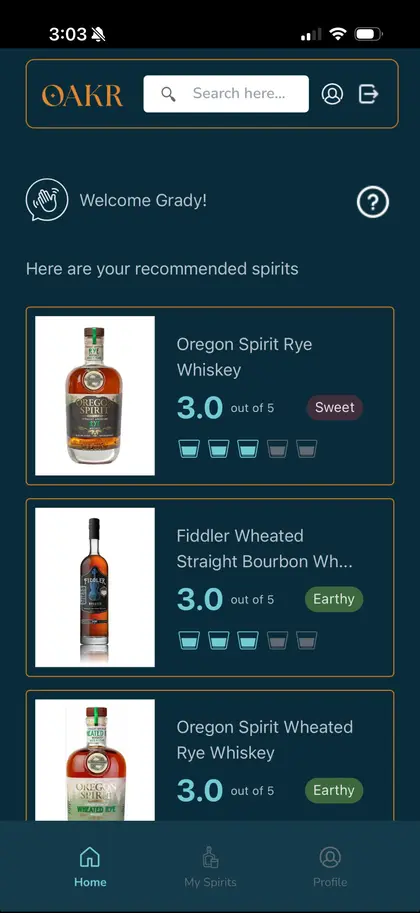
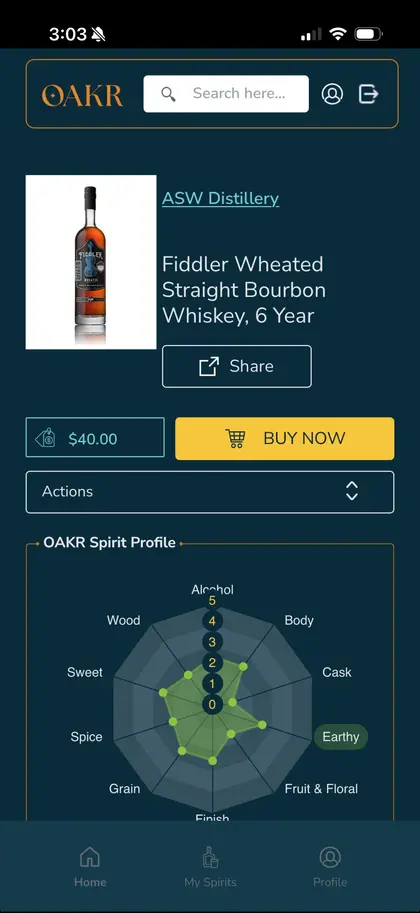
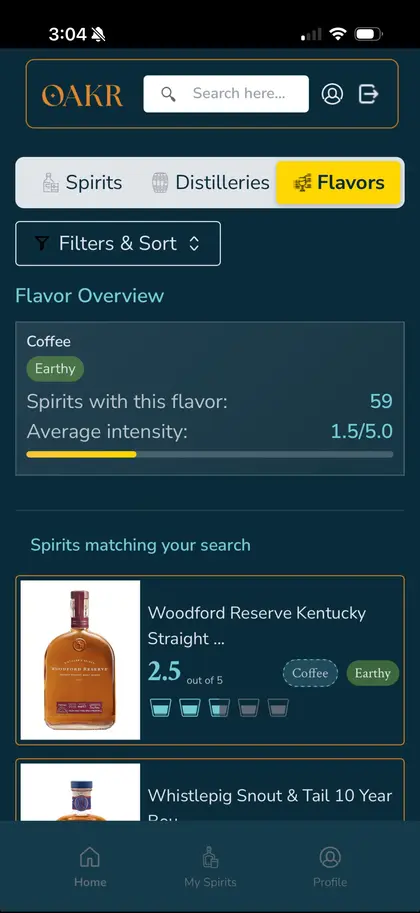
OAKR’s blind tasting panel scores every Beam expression across 100+ individual flavor notes in 10 macro categories. Your Spirit Match score tells you whether the Beam flavor profile aligns with your palate — and which specific expression, from White Label to Booker’s to Lineage, is the best fit — before you spend a dollar. For a lineup this deep, built on a single DNA, that precision is the most efficient way to find your bottle.
[Download OAKR free on iOS, Android, or web →]

Bourbon enthusiast, spirits industry analyst, and the voice behind OAKR's distillery guides, brand reviews, and bourbon education content. Visiting distilleries, dissecting mashbills, and translating the craft into data since 2024.
Same mashbill, same yeast, $18 to $250. Your Spirit Match score tells you which Jim Beam expression fits your palate best.