
Colby Frey's family had been farming the same land in Fallon, Nevada for 150 years before he decided to stop selling his grain to other people and start turning it into whiskey himself. That decision — made in 2006, formalized with the first distillery license issued in Nevada since Prohibition — is the one that defines Frey Ranch and separates it from virtually every other craft distillery in America. "Grain-to-glass" and "farm-to-flask" are phrases that dozens of distilleries use. Frey Ranch is one of the only operations on the planet where the phrase means exactly what it says: every grain in every bottle — the corn, the rye, the wheat, the malted barley — was planted, grown, harvested, malted, milled, mashed, fermented, distilled, aged, and bottled on the same 1,500-acre family ranch, by the same family that's been farming it since 1854. That's not a marketing distinction. It's a production reality that determines what the bourbon tastes like, how much it costs, and why it doesn't taste like Kentucky bourbon even though it's made with the same fundamental process. Everything about Frey Ranch — the four-grain mashbill, the Nevada desert aging, the non-chill filtration, the custom Vendome still — flows from the foundational decision to grow everything on-site.

The Frey family has been farming in the Fallon, Nevada area since 1854 — before Nevada achieved statehood in 1864. Frey Ranch sits in Churchill County, in the Lake Tahoe watershed, about an hour east of Reno along U.S. Route 50. The surrounding landscape is high desert — arid, sparse, and nothing like the rolling green hills of Kentucky.
Colby Frey grew up on the ranch. He and his wife Ashley started wine production on the property in 2001. In 2006, they obtained the first distillery license issued in Nevada since Prohibition and began making vodka, gin, and absinthe. The bourbon plan was always the long game. They distilled their first batch of bourbon in 2015 and didn’t release it until 2020, after five years of aging.
“Estate distillery” means Frey Ranch grows 100% of the grain used in their spirits on their own 1,500-acre farm. Every grain in every bottle — the corn, the rye, the wheat, the malted barley — was planted, grown, harvested, malted, milled, mashed, fermented, distilled, aged, and bottled on the same property.
Frey Ranch’s bourbon uses a four-grain mashbill: 67% corn, 12% malted barley, 11% rye, and 10% wheat. All four grains are grown on the ranch.
The critical detail: Frey Ranch malts their own barley on-site. Most distilleries buy pre-malted barley from commercial maltsters. Frey Ranch does it themselves, which gives them control over the malting temperature, germination time, and resulting enzyme activity and flavor contribution.
Using all four grains is unusual because it adds production complexity. The advantage is flavor complexity before the bourbon ever touches a barrel. The corn sweetness, barley maltiness, rye spice, and wheat softness all contribute distinct characteristics to the base spirit.
Frey Ranch uses a proprietary yeast strain. At an estate distillery, the grain’s character varies year to year based on growing conditions. Master Distiller Russell Wedlake’s job includes managing this interaction — adjusting fermentation temperatures, timing, and yeast propagation to account for the natural variation in estate-grown grain. The earthy, savory quality that reviewers consistently note in Frey Ranch bourbon is at least partly attributable to the specific grain varieties, soil conditions, and water source of this particular ranch.
Frey Ranch runs a custom-made Vendome still — a column still for continuous distillation and a pot still for making cuts. The water comes from the Lake Tahoe watershed, filtered through the Sierra Nevada mountains — mountain-sourced water, not the limestone-filtered water that Kentucky distilleries are known for.
Frey Ranch does not chill filter any of their whiskeys. The bourbon goes from barrel to bottle with its full complement of oils, fatty acids, and proteins intact.
Fallon sits at roughly 3,965 feet elevation in a high-desert climate. Summer daytime temperatures reach into the upper 90s and low 100s. Winter nights drop below freezing. The diurnal temperature swing can exceed 40-50 degrees in a single day.
That swing drives barrel interaction at a pace fundamentally different from Kentucky. The heat pushes spirit deep into the charred wood during the day; the cold pulls it back at night. In Kentucky, this cycle happens seasonally. In Nevada, it happens daily. The result is that Nevada-aged bourbon develops wood character, color, and flavor complexity faster per year of aging.
The arid Nevada climate drives higher evaporation rates. The angel’s share runs higher at Frey Ranch than at a Kentucky distillery, concentrating the remaining liquid but meaning less bourbon per barrel at bottling.
Colby Frey is a fifth-generation Nevada farmer who describes himself as a “whiskey farmer” rather than a distiller. Ashley Frey co-founded the distillery and manages business operations. Russell Wedlake serves as Master Distiller, handling the technical production.
Frey Ranch Straight Bourbon — 90 proof, ~$50. The flagship. Four-grain mashbill, non-chill filtered, estate-grown, Nevada-aged. Earthy, chewy, with vanilla and caramel anchored by a distinct rye spice and a savory quality that reads as leather and dry wood.
Frey Ranch Straight Rye — 100 proof, Bottled-in-Bond, ~$55. 100% winter cereal rye, estate-grown. Minty, fruity, peppery — surprisingly approachable for a 100% rye at bonded proof.
Farm Strength Uncut Bourbon — barrel proof, varies, ~$65-75. The Straight Bourbon at barrel strength — uncut, unfiltered, full intensity. Rich, oily, heavy caramel and oak.
Single Barrel Selections — barrel proof, varies, ~$70-80. Individual barrels selected by Wedlake. Each barrel is different — the estate model and desert aging produce meaningful barrel-to-barrel variation.
Single Grain Series — limited. 100% oat whiskey, 100% wheat whiskey. Educational bottles showing exactly what each grain contributes.
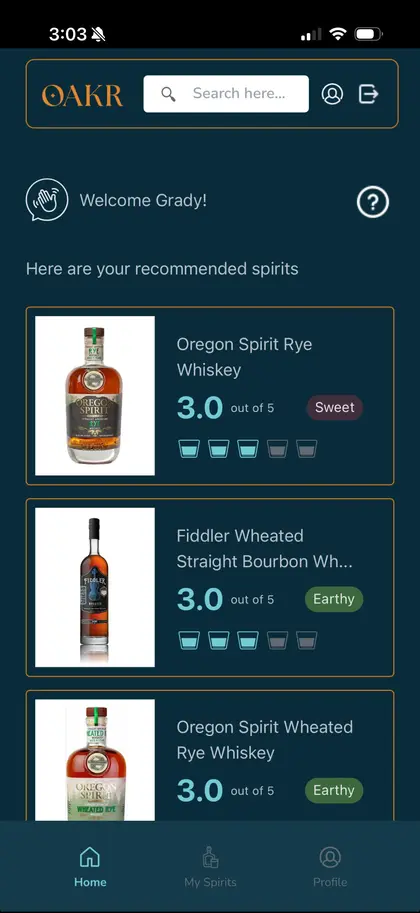
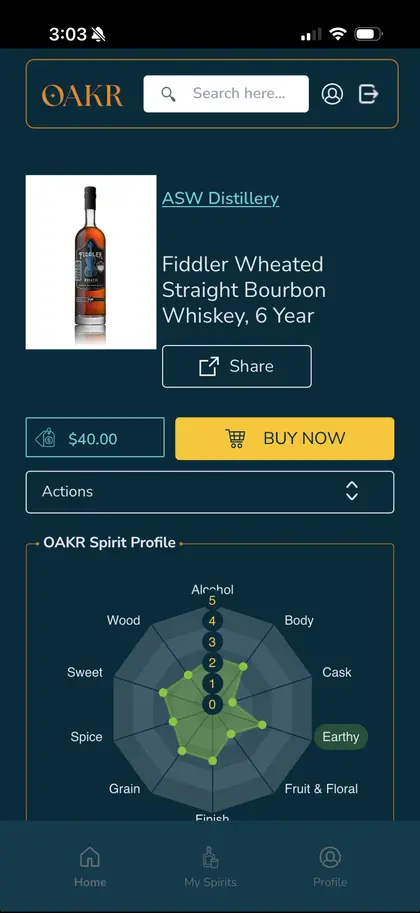
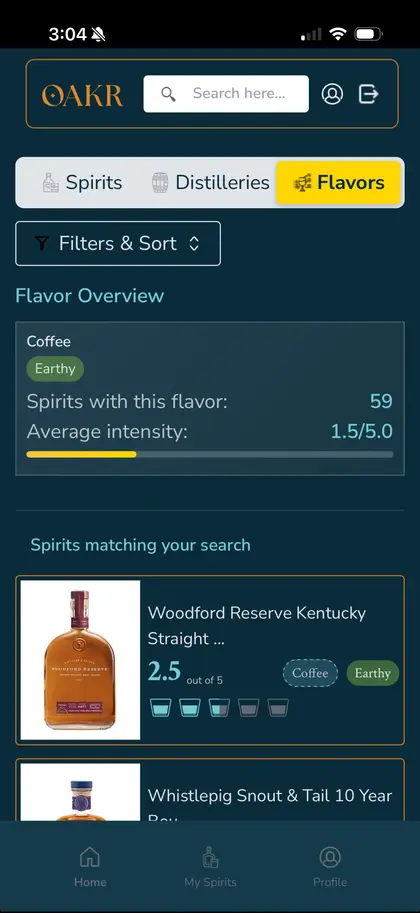
OAKR’s blind tasting panel scores every bourbon across more than 100 flavor notes, organized into 10 macro categories. Add a few bottles you already know you love, and the AI builds a palate profile that tells you whether Frey Ranch’s earthy, grain-forward, savory character is going to land as a revelation or a mismatch.
[Download OAKR free on iOS, Android, or web →]

Bourbon enthusiast, spirits industry analyst, and the voice behind OAKR's distillery guides, brand reviews, and bourbon education content. Visiting distilleries, dissecting mashbills, and translating the craft into data since 2024.

Four grains, one ranch, Nevada desert aging. Whether Frey Ranch’s earthy character fits your palate is a data question. Spirit Match answers it.